
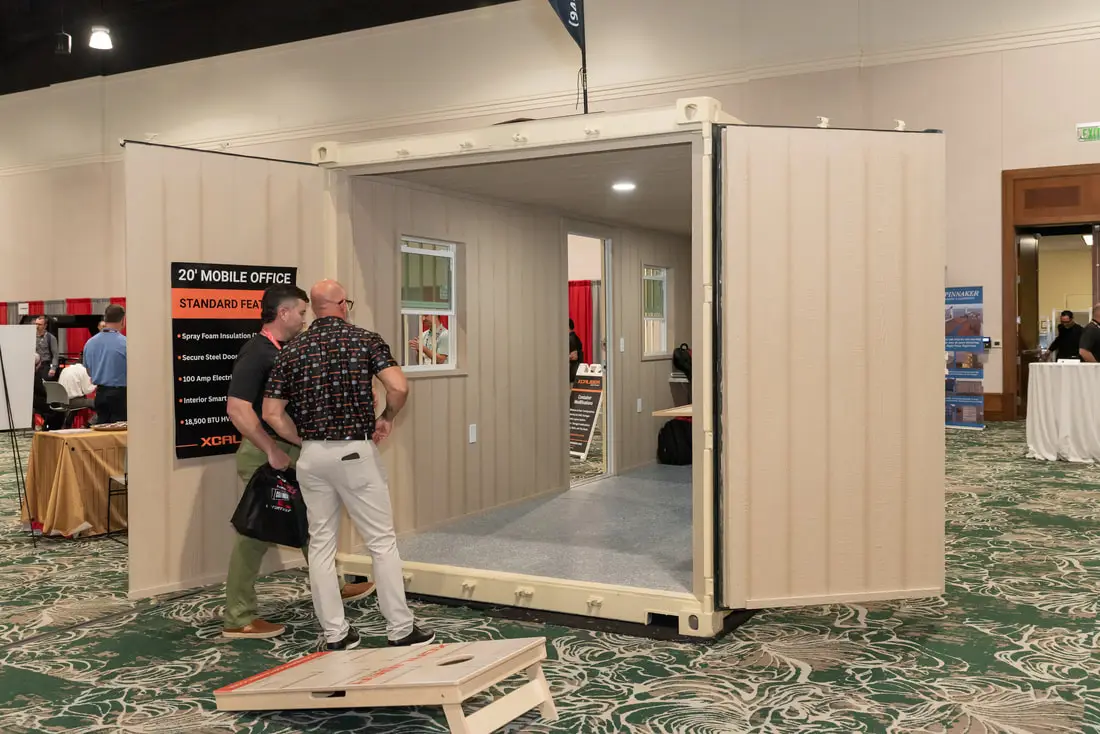
What is the difference between an office trailer, a container office and a modular building?
An office trailer rides on a wheeled chassis. A container office is built from a steel shipping container. A modular building is assembled from factory-built sections. All three give you a work space on site. They differ in size, lifespan, mobility and the work needed to install them.
Here is a side-by-side view. It draws on the Cassone and Triumph Modular pages listed in the sources.
| Feature | Office trailer | Container office | Modular building |
|---|---|---|---|
| Built from | Factory-built frame on wheels | Steel shipping container | Factory-built sections |
| Sits | Raised, on a chassis | On the ground | On blocking or a foundation |
| Best for | Short-term use | Longer stays in one place | Larger or permanent needs |
| Can it move again | Yes, easily | Yes, but it usually stays put | Temporary: yes. Permanent: no |
| Can it stack | No | Up to two floors, per Cassone | Yes, with design work |
| Typical lifespan | Lower | 15 to 20 or more years, per Cassone | Depends on the build |
Treat the table as a starting point. Every provider builds a little differently.
Which one is best for a short job?
A trailer is usually the best fit for a short job. Cassone calls mobile office trailers “best for short-term use,” and Triumph Modular says they are often the faster option when a unit is available and the site is ready.
Trailers arrive complete. Setup is mostly blocking, leveling, anchoring and utility hookups, according to Triumph Modular. Cassone lists common trailer sizes from 8 by 20 feet up to 24 by 64 feet. Ask your provider which sizes are in stock near you.
Trailers also take wear from repeated moves. That matters if the same unit changes sites often. It matters less if you only need it for one project.
When does a container office make more sense?
A container office makes more sense when the office will stay in one place for years. Cassone says container offices can last 15 to 20 or more years, and ground-level units may last over 20 years even after repeated moves.
Containers sit at ground level. That helps when people carry tools, rolls of plans or equipment in and out. You can also stack units up to two floors, per Cassone.
There are trade-offs:
- The upfront cost of a ground-level office can match or beat a trailer, according to Cassone.
- Assembly can be more complex and may involve electricians, plumbers or welders.
- Initial transport may need an oversize load permit.
- Permits can be harder to get in some regions, because the idea is newer.
Cassone also notes that buying can cost less than long-term renting. Do the math for your own timeline. A rental agreement with a longer term often lowers the monthly rate, but prices vary by market and provider.
When should you choose a modular building?
Choose a modular building when you need more space, a custom layout or a permanent building. Triumph Modular says modular sections can be combined to fit larger or more complex space needs, and that they scale up to multi-story facilities.
The trade-off is planning. Triumph Modular notes that larger modular projects need more design, permitting, site work and coordination than a standard trailer. Temporary modular buildings can be taken apart and moved. Permanent ones can sit on permanent foundations.
If your project needs a relocatable building that you plan to keep for years, start the permit conversation early.
How do I choose?
Start with three questions. How long do you need it? How many people will use it? What is the site like? Then match the answers to a type.
- Count the days or months. Under a year usually points to a trailer. Several years in one spot points to a container office or modular building.
- Count the people and the desks. Add room for plans, a meeting table and storage.
- Walk the site. Check access for the delivery truck, level ground, and where power will come from. The site preparation guide covers the basics.
- Ask about climate control. Cassone says trailers can come with air conditioning. Insulated container offices can handle harsh weather. Confirm what is included.
- Ask who handles permits and who pays for them.
Costs vary widely by size, duration, finish, delivery and market. Triumph Modular says cost depends on size, duration, customization, site conditions, delivery, installation and code requirements. Get at least two written quotes that list delivery, setup, pickup and monthly charges.
Do mobile offices need permits?
Often they do, but the rules are local. A city, county or homeowners association may require approval for a temporary structure, a utility hookup or a site plan. Never assume one rule applies everywhere.
Ask your provider what permits they usually see in your area. Then check with your local building department. The guide to permits and HOA rules explains who normally handles what. For a job site, your general contractor may also hold the permit.
What should I ask a provider?
Ask about the unit, the delivery and the terms. A short list keeps the call simple:
- What size and layout are available, and how soon can you deliver?
- Is power, lighting, heating and cooling included?
- What does the quote say about delivery, setup, pickup and minimum term?
- What site prep do you need from me?
- Who handles permits and inspections?
The guide to choosing a provider has a fuller checklist. You can also read about mobile offices on this site. NPSA does not rent offices itself. Its member companies do.
Next step
Tell us what you need, the site and the dates. An NPSA member company near you will contact you with options. Request a quote.