
Is portable storage the same as mobile storage?
Mostly, yes. In everyday use, both terms describe a storage unit that a company brings to you. You fill it at your own pace. Then the company leaves it on your property or hauls it to a storage center. Extra Space Storage’s moving guide describes portable storage containers and says they are “also called mobile storage containers.”
The words stay loose because no single rule defines them. A few trade terms do point to specific products, though. That is where the real differences sit.
What kinds of units do these terms cover?
Three unit types cover most of what customers rent. NPSA members offer all three.
| Unit type | What it is | Sizes NPSA lists | Typical use |
|---|---|---|---|
| Portable storage container | Steel container, often shipping-container style | Lengths from 5 ft up to 53 ft | Home projects, businesses, job sites |
| Mobile self-storage unit | Smaller unit built for moving and storing | 7 ft to 20 ft long, 8 ft standard height | Household moves, short-term storage |
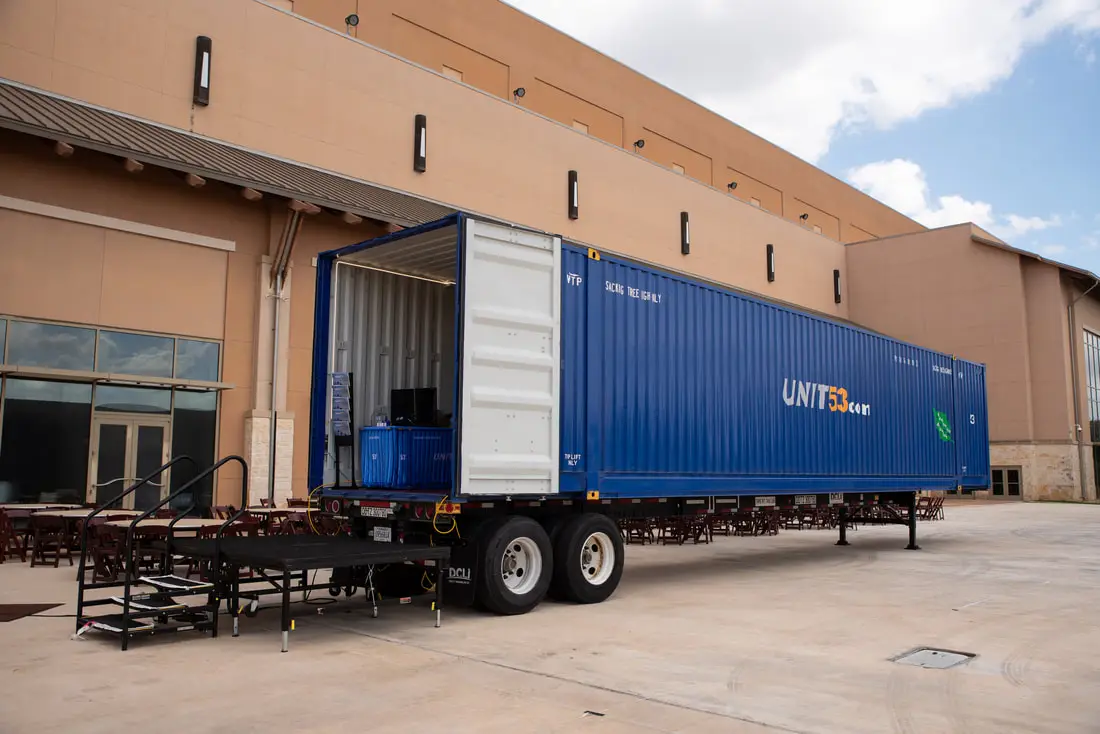
| Storage trailer | Road trailer used as storage | 28 ft, 40 ft, 45 ft, 48 ft, 53 ft | Retail overflow, large business needs |
NPSA members’ containers are made from corten steel, with corrugated steel sides and marine plywood floors. The smaller 7 ft to 20 ft mobile self-storage units are a separate product.
Prices vary by market and provider. As one reference point, Extra Space Storage’s guide lists $700 to $900 for local moves under 100 miles and $2,000 to $7,000 for long-distance moves. It says extra months often run $150 to $250 each. Treat these as ballpark figures, not quotes.
How do containers and mobile self-storage units differ?
Size and build are the main differences. A portable storage container, see NPSA’s container page, is usually a steel box that can be much larger. A mobile self-storage unit, see NPSA’s mobile self-storage page, is smaller and made for household moves.
Here is how that plays out for you:
- Space. Containers offer more choice at the top end. Mobile units stay compact.
- Delivery. Smaller units can fit tighter drives. Large containers need more room for the truck.
- Use. Mobile units suit a home move. Containers suit a long renovation or a business.
If you are unsure how much space you need, read our guide on what size portable storage container to get.
Which units can be moved when they are full?
Moving containers and mobile self-storage units are made for that job. Extra Space’s guide describes the process: you pack, the company picks up the sealed unit and takes it to your new address or to a storage facility.
Large steel containers can also be moved, but the provider decides how. Weight limits differ by company. Ask your provider how heavy a loaded unit may be before you pack.
A storage trailer is the odd one out. It sits on wheels. Businesses often use it near a loading dock.
What about the history of the terms?
The two terms have no formal definition or documented history. What matters for you is simple. NPSA is named for “portable storage.” NPSA uses “mobile self storage” for a specific product. The terms overlap, and providers define them their own way.
How do you pick between them?
Start with what you need to do. Then ask each provider what exact unit they will deliver.
- Decide if you need the unit on site, in a storage center, or both.
- Estimate how many rooms of belongings you have.
- Check your driveway or site for truck access.
- Ask for the unit’s length, height and weight limit.
- Ask whether the price includes delivery, pickup and the first month.
Your local rules matter too. Some cities and homeowner associations limit where a unit can sit. Check your local rules and ask your provider.
What is the difference between on-site and off-site storage?
Both terms cover two ways to use a unit. The unit can stay at your home or business, or the company can take it to a storage center.
| Option | What NPSA says | Best for |
|---|---|---|
| On-site storage | NPSA says you have “complete access to contents 24/7 while the container sits on your property” | Remodels, job sites, daily access |
| Off-site storage | NPSA says most companies give access while the unit is in their storage center, if required | Gaps between moves, no room at home |
Ask each provider how access works at the center. Some need an appointment. The rules differ by company.
What should you ask a provider?
The same words can mean different units. These questions clear it up.
- What are the exact length, width and height of the unit?
- What is the maximum weight I may load?
- Can the unit stay on my property, and where will the truck put it?
- Is there a storage center, and can I visit it?
- What are the monthly rate, delivery fee and pickup fee?
For more detail, our guide on how to choose a portable storage provider covers contracts and reviews.
Next step
Tell us where you are and what you need to store. An NPSA member company near you will contact you. Request a quote.